Build-to-rent has moved far beyond the idea of simply delivering units for long-term lease. Large rental developments now launch more like consumer products than traditional housing stock. Leasing teams begin outreach months before completion. Investors track absorption rates closely. Marketing pipelines run in parallel with construction schedules. In this environment, 3D rendering for real estate has taken on a functional role that extends well past visual presentation. It has become part of how projects are introduced, positioned, and financially stabilized before the first tenant moves in.
The lease-up clock starts early
Vacancy is expensive at scale. Every unleased unit in a new rental community represents carrying costs, operational drag, and delayed returns. For institutional developers, lease-up speed is not a vanity metric. It is tied directly to financing structures and investor confidence.
That pressure shifts marketing timelines forward. Outreach cannot wait for completed interiors or finished landscaping. Leasing teams need assets while the project is still surrounded by scaffolding. Floorplans alone do not convert interest into signed agreements. Prospective tenants want to see how a space will feel, not just how it is measured.
3D renderings fill that gap. They allow leasing campaigns to start while construction crews are still pouring concrete, giving developers a head start on occupancy.
Pre-leasing campaigns need visual inventory
Leasing online has become a visual-first environment. Property platforms, sponsored social placements, and dedicated campaign pages all push image-led listings higher. When a project launches backed only by written descriptions and plan drawings, it steps into competition already constrained.
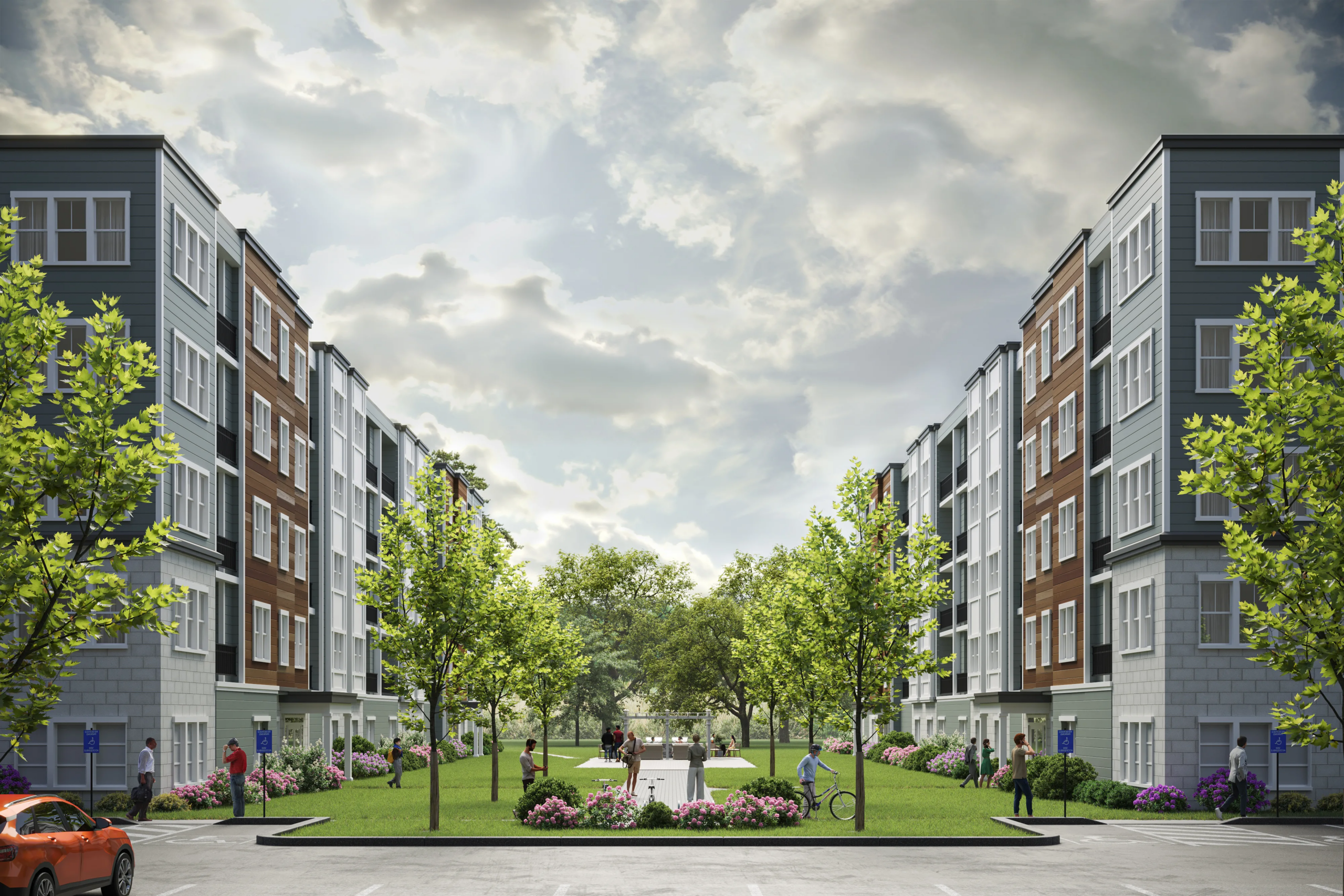
Interior and exterior 3D renderings provide the visual inventory needed to activate these channels early. Leasing teams can publish unit types, showcase design finishes, and introduce the broader environment long before photography is possible. This is especially important in markets where renters compare multiple new developments simultaneously.
The advantage is not aesthetic. It is operational. More channels open earlier, inquiries start sooner, and leasing pipelines build before construction ends.
Amenities sell the community, not just the unit
In build-to-rent developments, competition rarely comes down to unit size alone. Shared environments shape renter interest just as powerfully as private layouts. Fitness rooms, rooftop decks, social lounges, work hubs, and landscaped outdoor zones all play into perceived value.
3D renderings allow developers to stage these spaces in use. A co-working lounge feels active rather than empty. A rooftop terrace reads as social infrastructure, not just outdoor square meters. Prospective tenants can imagine routines forming within the property, which strengthens emotional buy-in during pre-leasing.
Branding the development before it opens
Large rental communities operate as branded environments. They carry names, positioning strategies, and lifestyle narratives designed to attract specific tenant segments. Some target young professionals. Others lean toward families or corporate renters.
3D rendering helps construct the development’s public identity. Surface finishes, light quality, exterior greenery, and overall visual mood shape first impressions. When carried consistently through brochures, advertising, and leasing platforms, the property begins to register as real long before completion.
This consistency matters. It signals professionalism, reduces perceived risk, and helps prospects understand where the development sits within the rental hierarchy.
Investor communication runs on visuals too
Tenant acquisition is only one side of the equation. Build-to-rent projects answer to investors, lenders, and institutional partners who require regular progress updates. Financial reports carry weight, but visual documentation strengthens confidence.
3D renderings help illustrate the intended finished state alongside construction milestones. They show how amenity investments translate into tenant appeal. They also support presentations tied to refinancing, phased expansion, or asset portfolio marketing.
In this context, visuals operate as persuasion tools. They translate construction progress into market readiness, reinforcing the project’s long-term revenue narrative.
Leasing remotely requires stronger trust signals
Remote leasing now spans both local and international renter pools. Companies move employees between cities and countries. Individual tenants sign for units without stepping inside, often limited by distance or time.
For these renters, renderings become practical decision tools. They stand in for repeat visits, enable virtual tours, and clarify layout, light, and finishes. When visuals appear cohesive and fully resolved, hesitation tends to ease.
This is particularly relevant for large developments targeting relocation corridors or international talent hubs. Early trust directly affects pre-leasing velocity.
A scalable content engine
Marketing for build-to-rent does not end at launch. Leasing campaigns continue through phased openings, additional unit releases, and seasonal demand cycles. Photography alone cannot sustain that content volume, especially while parts of the development remain under construction.
Rendered assets scale more easily. They can be reformatted for social campaigns, integrated into video walkthroughs, refreshed for portal updates, or repurposed for email marketing. The same visual base supports multiple outreach waves without requiring physical re-shoots.
This turns real estate rendering into a renewable marketing resource rather than a one-time deliverable.
From marketing add-on to launch infrastructure
As build-to-rent matures, the way these projects are launched continues to change. Leasing, branding, investor communication, and marketing no longer wait for construction to finish. They move forward at the same time. Rental communities are now introduced to the market while they are still being built, and sometimes even before ground is broken.
Within that compressed timeline, visual communication becomes foundational. 3D renderings allow developers to pre-lease, position amenities, secure investor confidence, and scale marketing output without waiting for physical completion.
What was once considered a presentation layer now functions as launch infrastructure. And as rental communities grow larger and more competitive, that infrastructure is quickly becoming standard practice rather than a differentiator.